
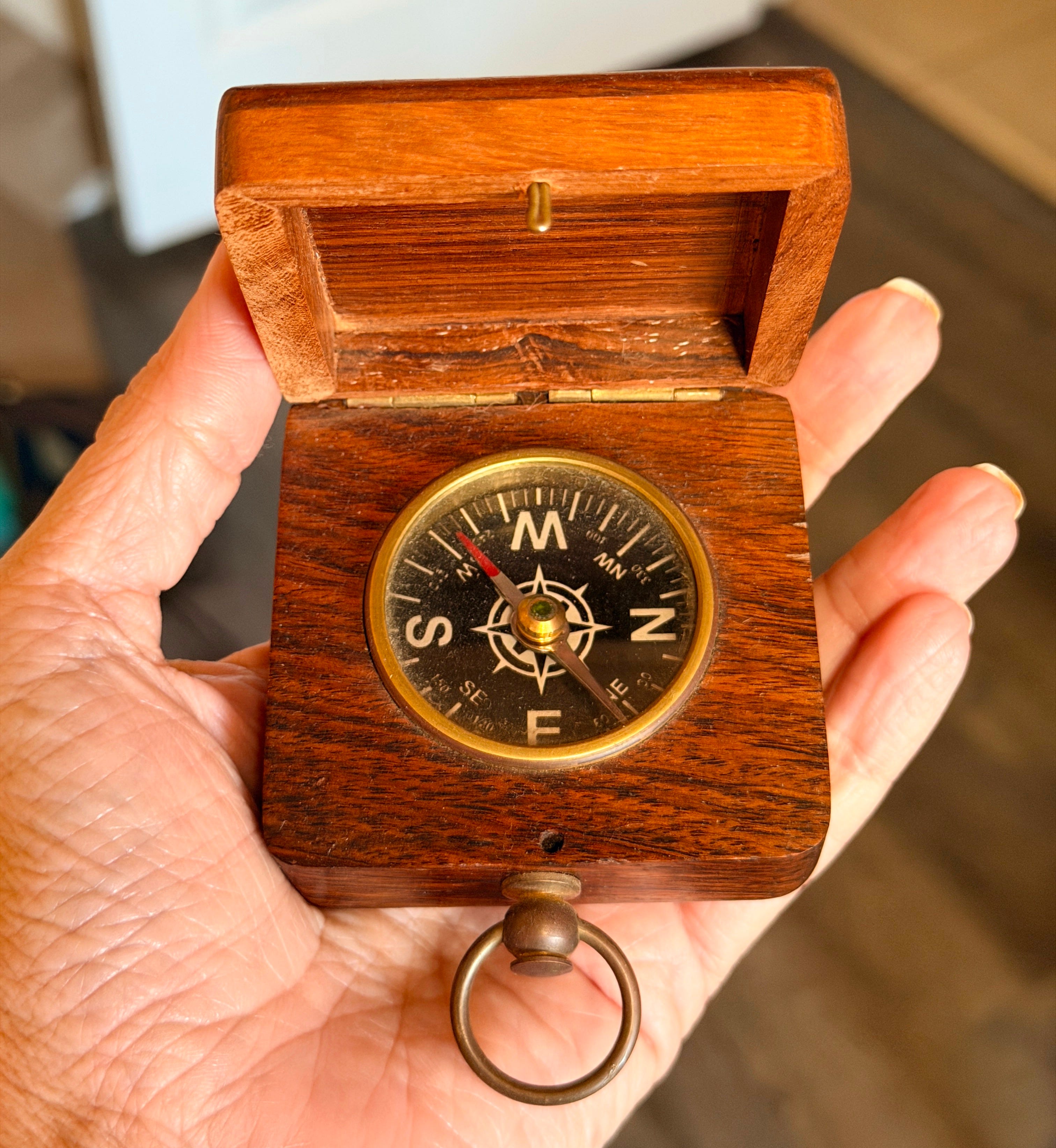
My first boss as a leader gave me a compass when he retired.
Point true north, he said, or something close to it. I don’t remember the exact words because my memory is shot. But I do remember thinking it was a cool thing to hand someone, and I remember, years later, understanding why it was the thing he chose to give me. He gave me the compass because he couldn’t give me a career’s worth of experience. (This was long before I ever wrote a word about reading terrain, by the way. Funny how the universe works…)
There’s a quote I have seen so many times in leadership blogs and Instagram quote accounts: Success leaves clues. Study the people who made it, find what they did, do that. It sounds so smart because it is half of a true thing. The half it leaves out is the part that I think matters more
The Clarity Was Not a Technique
My boss led with clarity and integrity, and when I was new I tried to figure out how he did it. I studied his every move. His presentation style; his email tone; and the way he walked in to a room. I even watched how he ran a hard conversation and tried to copy the moves.
I could not copy it. Not because I wasn’t paying attention, but because the thing I was trying to copy wasn’t a technique. It was a residue. His clarity was built off of thirty years of mistakes wearing a clean shirt, and I did not have the mistakes yet. If I had successfully copied the output, I’d have copied the one thing that couldn’t transfer, because it wasn’t a skill he was performing. It was a scar that had healed a certain way.
Most successful leaders show up polished and let you assume they walked in like that. They present the finished version. The clues are there, technically, but they’re buried under the presentation, because nobody’s incentivized to show you the wound.
My boss did the opposite. That was the rare part, and the part I value so much more than any leadership book or training.
The Empty File
He told me once about a person he couldn’t terminate.
The employee wasn’t able to do the job. My boss knew it, the team knew it, and when he finally moved to let the person go, the union stopped him cold. He didn’t have the paperwork. No documented attempts to counsel, no record of redirection, no file showing he’d tried to bring the person along before giving up on them. The file was empty. So the person stayed, and the mission carried the cost of it, for a long time.
That was the wound.
And it explained something I’d felt without understanding. He had no hesitation about hard conversations with me. He’d tell me straight when I was getting something wrong, and I got a lot wrong that first year. After all, I was a new leader making rookie mistakes at a respectable clip, so he had material to work with. But it never felt like a reprimand. It felt like he wanted me inside the success of the thing we were building, and he was clear that this was the reason.
I understand now that his directness wasn’t a personality trait. He wasn’t born unafraid of conflict. He’d once been conflict-avoidant enough to leave a file empty, and it had cost him a person he couldn’t remove and a mission that dragged. The grace he brought to a hard conversation was scar tissue over that exact place. He talked to me directly because he knew, in his body, what silence could cost.
That’s the clue. Not his clarity. The empty file underneath it, and the fact that he chose to show me the file.
What He Could Not Hand Me
You cannot give someone your mistakes.
That’s the real limit of success leaves clues. The clue that matters most is usually the one that doesn’t transfer, because it isn’t a move, it’s a mark left by something that already happened to you and hasn’t happened to them yet. He couldn’t hand me the empty file. He couldn’t hand me the years. So he handed me a compass, which is a beautiful object and also, I think, a confession that the most important thing was the one thing he couldn’t pass across.
What he actually gave me wasn’t the direction. It was the permission to make my own scars legible instead of smoothing them over. To leave the clues out where the next person can read them, empty file and all, rather than presenting the clean version and letting them believe I arrived this way.
Success leaves clues only when someone decides to leave them. Most success buries them. He dug his up and set them on the table for me.
A question for you
What is one scar underneath how you lead that you’ve never let anyone see, that would teach the person coming up behind you more than any polished version of you ever could?
Reply and tell me. I read every one.
(Thank you to Claude AI for helping me ground this reflective moment into something tangible for others!)
Trying to imitate the behavior of an experienced person usually leads to the reproduction of the surface.
The external image is easily copied.
Inner confidence is not, because it was built through choices that carried a cost.
When attention remains on the way a decision is expressed, the path that made it necessary is bypassed.
Learning begins where the reason is revealed, not the final move.