
I put one slide up at the conference: the same assignment shown three ways. On paper, in a Google Doc, and built into an AI tool. Then I asked which version was better, and the room came alive.
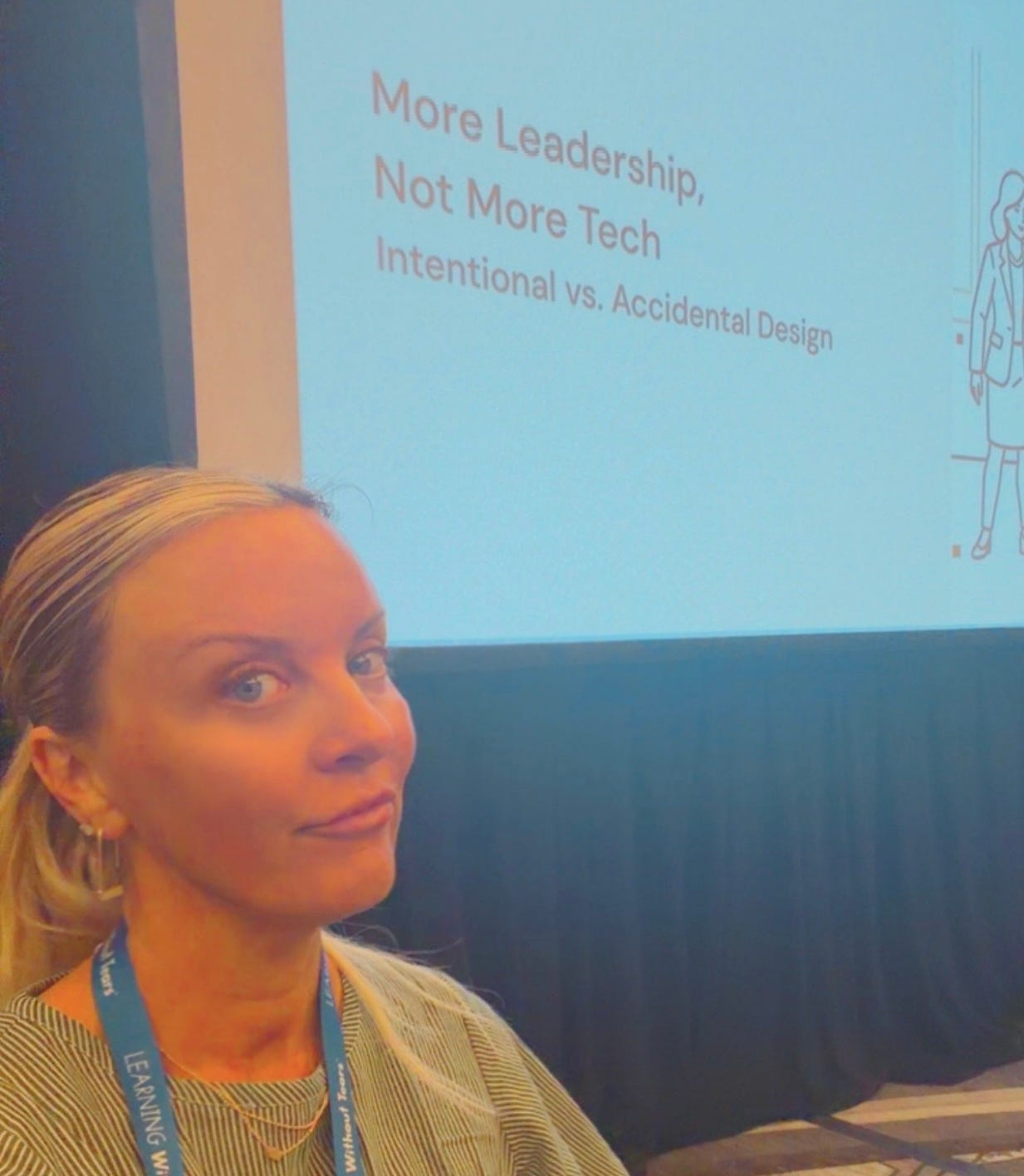
Hands went up for all three. Someone made the case for paper because it strips out the distraction. Someone argued for the AI version because of the instant feedback. Someone defended the Google Doc because it’s flexible and shareable. Good arguments, all of them, delivered with the confidence of people who do this for a living.
Then I changed the question. Assume all three were badly designed. What would make them bad? The room got quieter, and the answers got sharper. A worksheet that only asks a student to recall a definition is thin whether it’s printed or pixelated. An AI tool can deepen thinking or skip it entirely, depending on what you ask it to do. The quality of all three came down to one thing: how much actual thinking the task demanded. The format had very little to say about it.
That is the conversation I keep ending up in, and it is rarely just about schools. The same shape shows up around a new CRM, an AI meeting assistant, a reorg, a fresh policy. We debate the tool with real energy and skip the question sitting underneath it, which is whether we designed the thing on purpose. So I started running everything new through four questions before anyone gets to vote.
1. What is this for?
Say what the thing is for in one sentence you’d be willing to write on a whiteboard. If the honest answer is “everyone else has it” or “leadership wants to see us using AI,” you’ve found your problem, and no tool is going to fix it. (At CUE, the people who wrestled most with this question weren’t the skeptics. They were the ones already three tools deep, who couldn’t finish the sentence “this is for ___” without trailing off.)
2. What does it strengthen?
Every tool strengthens something, so name the actual muscle and be honest about whether it’s the one you care about. Speed? Output? Collaboration? This is where the research gets a little uncomfortable. John Hattie’s work keeps landing on the same place, which is that clarity of purpose and cognitive challenge move learning far more than the format you deliver it in. Daniel Willingham put it plainly: we remember what we think about. So if the shiny new thing strengthens activity without strengthening thinking, you’ve bought motion and called it progress.
3. What does it replace?
People skip this one, because the honest answer is usually “a person, a habit, or a moment of friction that was doing quiet work nobody credited.” Cognitive load research has a warning here too: stack a new system on top of the old ones without removing anything, and the only thing you reliably add is weight. The AI note-taker I once approved replaced the thirty seconds a team used to spend at the end of a meeting asking “so what did we actually decide.” That friction looked like inefficiency, which is exactly why it was first on the chopping block. It was also the only moment we reliably turned talk into a decision.
4. What does it make too easy to do poorly?
Every tool lowers the cost of some action, and it lowers the cost of doing that action badly at the same rate. This is the question most people skip, because answering it means saying the downside out loud. AI writing makes it easy to send a thoughtful-sounding note to someone you should have called. Dashboards make it easy to manage the number instead of the thing the number stands for. And my favorite, the one that got the biggest laugh of recognition in the room: a classroom (or a meeting, or a Slack channel) can look busy, collaborative, fully engaged, and demand almost no thinking at all. Students copy-pasting into a shared doc look exactly like students building an argument together... right up until you read what they wrote.
Every tool you adopt is a quiet decision about what your people will stop paying attention to. Most teams never write that part down, so they learn it the hard way, in a room that looks engaged and is quietly thinking about nothing.
A Question for You
What are you currently defending in your work that you have not actually examined?
If a tool or a policy came to mind while you read that, hit reply and tell me what it was. I read every one, and the things people are quietly defending are usually the interesting part.
Before you go.
If this essay said something you have been trying to put into words, the most useful thing you can do for someone else who needs to hear it is share it.
Read the Terrain grows when leaders pass it to other leaders. Not through algorithms, not through ads, just one quiet recommendation at a time.
You will earn access to subscriber-only content the more people you bring along. They get something worth reading. You get acknowledged for being the person who sent it. Everyone wins.
I remember in the late eighties and early nineties the conversation about computers and their impact on and in both business and personal lives.
The questions were somewhat similar what can they be used for? What do they strengthen and what do they weaken? And the elephant in the room was who or what will they replace?
And only time could answer those questions. We often lack the imagination that is open enough to see what the future holds. Great post!